Illinois Concrete Pipe Handbook
This is an independent reference on reinforced concrete pipe, precast box sections and related drainage structures as they are specified, manufactured, installed and tested for Illinois sewer and culvert work. It collects, in one place, the material a design engineer or inspector reaches for repeatedly: the product standards, the class-selection tables keyed to diameter and fill height, dimensions and approximate weights for circular, elliptical and box sections, joint types, and the acceptance tests that decide whether a finished line is accepted.
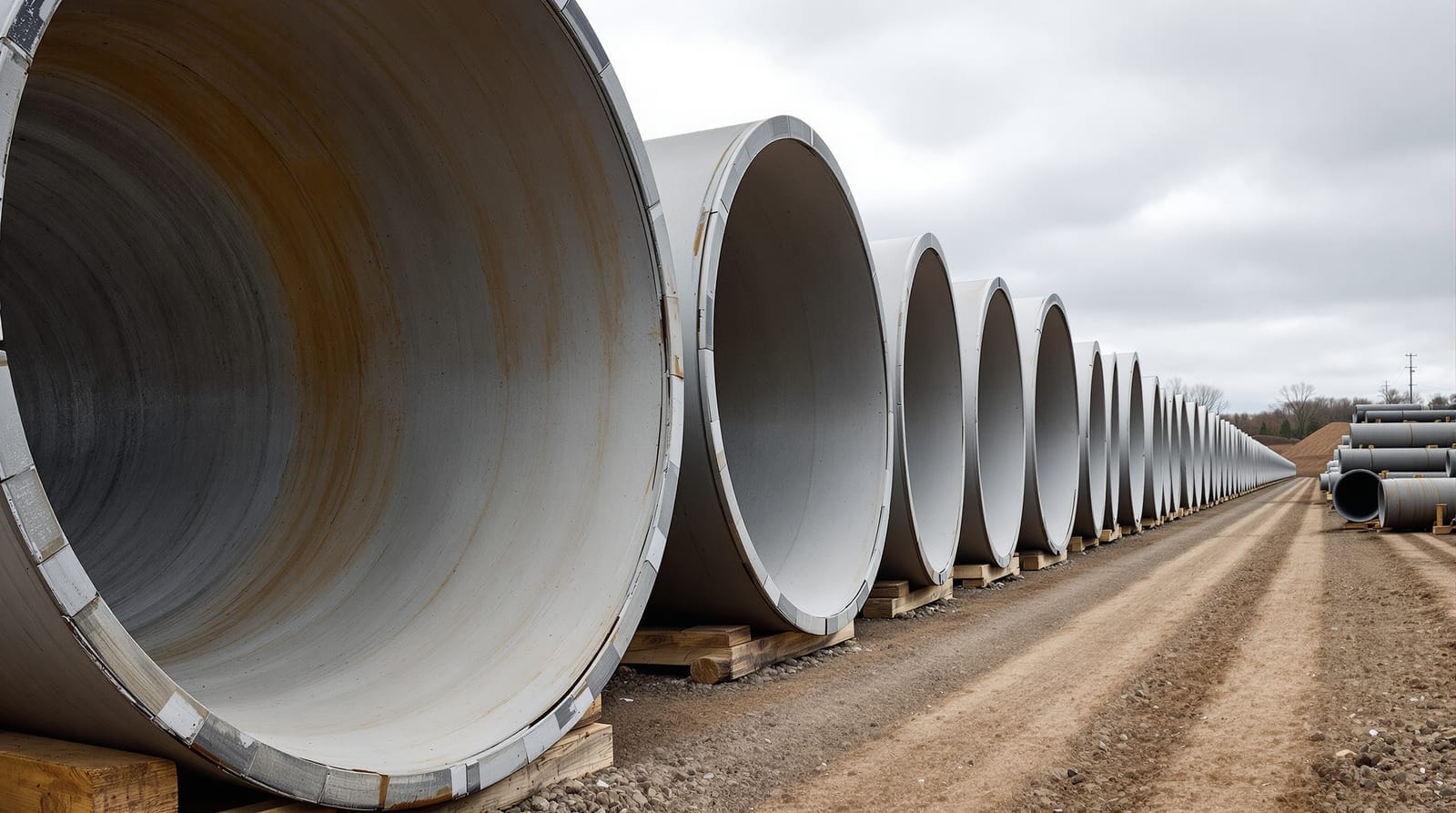
Concrete pipe has carried drainage in Illinois since the nineteenth century, and a great deal of that pipe is still in service. That longevity is the reason the specifying detail matters. A conduit that will sit under an embankment for a hundred years is chosen once, on paper, from a handful of tables — and the consequences of choosing badly are washouts, differential settlement and excavation that costs many multiples of the original material.
How this handbook is organised
The material follows the shape of a printed use manual rather than a marketing site. Each section is short, self-contained and linked from the full contents.
- Background — the introduction covers why concrete pipe behaves the way it does and what the national specification framework is for.
- Storm sewers and culverts — an overview, the applicable specifications and recommended use for each product, and the class-selection tables for storm sewers, circular culverts and elliptical and arch culverts.
- Sanitary sewers — a recommended standard specification covering materials, trench, bedding, installation and backfill, plus leakage allowances and protective linings.
- Components — joints and gaskets, manholes, catch basins and inlets, flared end sections and fittings.
- Verification and design — plant and field testing, hydraulics and durability, load capacity, cracking and jacking, and the design aids published elsewhere in the industry.
- Data — standards indexes and dimensions and weights for circular, elliptical and box sections.
Plan with dimensions and weights
Dimensions and weights should be read before a layout becomes a final schedule. Hydraulic selection establishes the required waterway, but the resulting section still has to fit between utilities, pass through the available work area and reach its bed with suitable handling equipment. The circular pipe dimensions and weights bring those questions forward by placing inside diameter, outside size implications and approximate weight in one working table. Early review can expose a clearance or access constraint while alignment, structure location and product choice can still be coordinated.
The same review connects design decisions to construction planning. Approximate weight helps frame unloading, staging, lifting and hauling requirements; wall thickness affects the outside envelope at a given waterway; and section geometry influences the space needed to make a joint and verify line and grade. These figures are planning data, not a substitute for the producer's schedule or the lifting information for the supplied pieces. A sound sequence is to select the hydraulic opening, check structural class and cover, compare the physical envelope with the site, and then confirm the final product data against the governing documents before work begins.
Why concrete pipe is specified
Rigid concrete conduit earns its place on six grounds, and it is worth naming them separately because they are frequently collapsed into one another. It is hydraulically efficient, with a roughness coefficient at the low end of anything available. It is structurally versatile: the pipe itself carries the load, so the installation does not depend on the surrounding soil developing passive resistance the way a flexible conduit does. It is locally available across the state. It is durable against abrasion, fire and the ordinary chemistry of domestic sewage. It is adaptable in the field, with bends, tees, wyes and transitions manufactured to the same standards as the barrel. And over a design life measured in generations it is usually the lower total cost.
Standards, not opinions
Almost every recommendation on this site traces back to a published consensus standard — an ASTM product specification, its AASHTO twin, a state standard specification for road and bridge construction, or a national design manual. Where a figure is quoted here it is quoted as data; the governing document always wins. Engineers working to current requirements should confirm designations and values against the current editions and against the specifications published by the Illinois Department of Transportation and the design literature of the American Concrete Pipe Association.
Editorial independence
This handbook is written and maintained independently. It sells nothing, represents no manufacturer, and speaks for no trade body. See about this reference for the full statement, including which organisation this site is not.