Leakage Allowances and Protective Linings
Plant testing
Most manufacturers will test sewer pipe in the yard before shipment to confirm that the barrels do not leak. Random vacuum testing of an assembly of two or more sections can also be carried out at the place of manufacture to confirm the integrity of the joints as made under controlled conditions. This matters because it separates two variables that are otherwise inseparable on site: whether the product leaks, and whether the installation leaks.
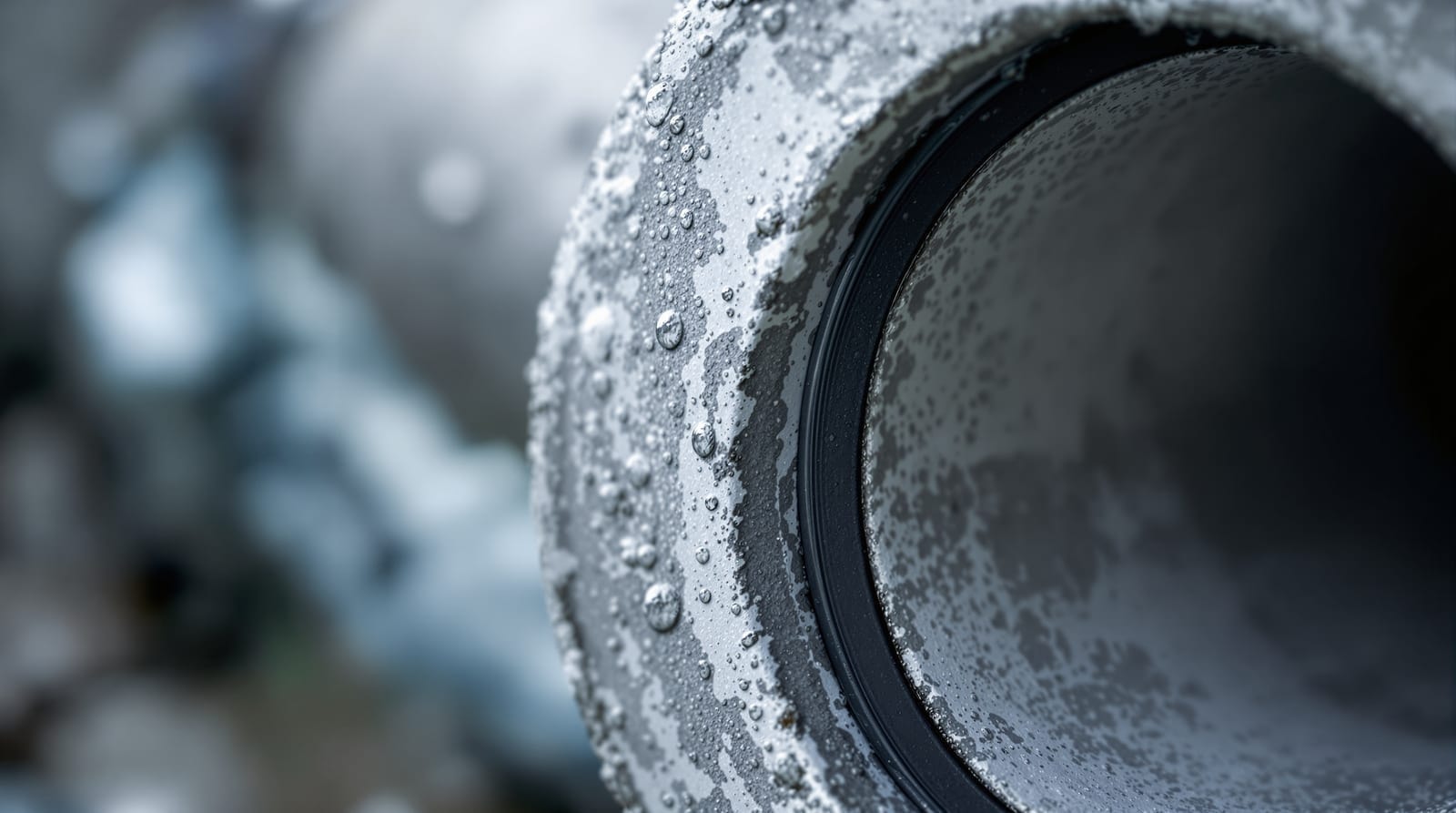
Field testing and what the allowance is for
Infiltration should be held to a minimum in a sanitary sewer. Groundwater entering the line consumes carrying capacity that was paid for, raises treatment cost at the works for water that never needed treating, and — more insidiously — carries soil fines in with it, which over years creates voids alongside the pipe and eventually surface settlement.
The essential point about a field leakage test is that it evaluates the contractor's workmanship, not the pipe. Field performance is the sum of the manufactured joint characteristics and the installation practice, and the manufactured half has usually already been verified in the plant. Low leakage requirements are readily met with well-made concrete gravity sewer pipe and rubber gasket joints, provided the joints are made properly.
Making them properly is a small number of specific things. The pipe being installed should be held by the lifting device straight to line and grade with the pipe already in the ground. It must not be held at an angle when entry starts, or the gasket will be pinched between the shoulder of the spigot and the bell at the bottom of the pipe — the single most common cause of a joint that fails a test on a line where everything else was done correctly. With the spigot carefully aligned at the entrance to the bell, and the pipe held in line with the previously laid section, the joint should be pulled home slowly.
Setting a limit
Project specifications normally state maximum allowable leakage as water infiltration or exfiltration, and they should state it two ways: a maximum allowable rate per test section and a maximum allowable average rate for the project as a whole. One bad reach can hide inside a project average, and a project of uniformly marginal joints can hide behind a generous per-section limit.
There is more opinion than hard data behind infiltration requirements. There will always be some increment of leakage that is not cost-effective to eliminate: the expense of the pipe, plus the construction and inspection cost of chasing the last small quantity, sets a practical floor. Experience indicates that a limit of the order of 200 gallons per mile per inch of diameter per day can normally be achieved in manhole-to-manhole testing with minimum or no effect on construction cost, which makes it a defensible place to set a specification.
A higher allowance should be used for an exfiltration test than for an infiltration test of the same line. This is not a concession; it reflects the physics. The exfiltration test is run with a definite internal head, and clear water being pushed out of the pipe is far less likely to be self-limiting than groundwater mixed with soil fines being drawn in — the latter tends to plug the very path it is leaking through. A single limit applied to both tests is therefore stricter in one direction than the other without anyone intending it.
Federal guidance on sewer system evaluation, rehabilitation and new construction remains the standard reference for leakage allowances and test methods; see the sewer programme material published by the US EPA.
Protective linings and coatings
Current design methodology allows the sulfide potential of a sanitary sewer to be predicted rather than discovered. Where prediction indicates that hydrogen sulfide generation will be significant — long detention times, warm temperatures, low velocities, high sulfate — linings or coatings may be specified to protect the inner pipe surface from the acid produced when sulfide is oxidised above the water line. The prediction is the important step; retrofitting protection into a corroding sewer is enormously more expensive than specifying it at the outset.
Liners
Available liners consist of a sheet of plasticised PVC with T-shaped keys running longitudinally along one face. The keys are cast into the concrete pipe during manufacture, so the liner is mechanically anchored into the wall rather than adhered to it. PVC liners of this type have been in successful service for well over thirty years, which is a longer record than most protective systems in any industry can show.
Coatings
Coatings may be coal tar epoxy, polyethylene or polyurethane. Coal tar epoxy is applied by spraying, either during or after manufacture, in varying thickness. These coatings are effective subject to three conditions that are genuinely conditions rather than recommendations: adequate surface preparation, adequate applied thickness, and adequate quality control during application. Where any of the three is not met the coating fails locally and the failure concentrates attack at that point.
The mechanism of sulfide attack, and the conditions that generate it, are described under special considerations. Joint types and their relative tightness are covered under joints.