Manholes, Catch Basins and Inlets
A sewer or culvert system is not only pipe. Manholes, inverted siphons, catch basins, inlets, flared end sections and fittings such as bends, tees and wyes are all necessary for the system to function and to be maintained, and the concrete pipe industry has developed most of the common appurtenances and specials required to make the whole thing work economically.
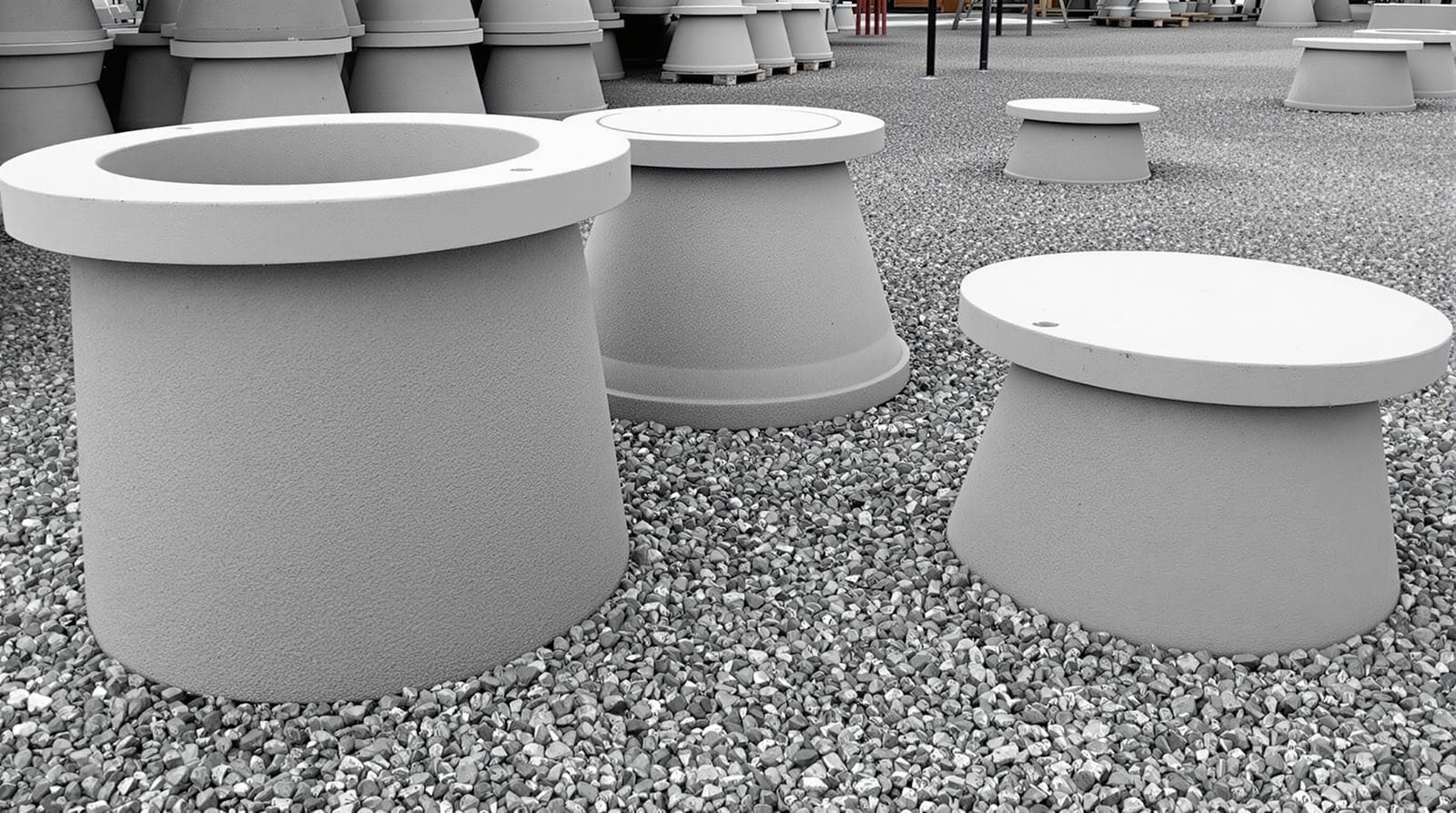
Manholes: ASTM C 478 precast reinforced concrete manhole sections
C 478 sections — risers, base sections and appurtenances such as grade rings and flat slab tops — are used in 36 in. and larger diameters. For large sewers over 3 or 4 ft in diameter, precast base tees are also available, which avoids building a base around the pipe in the field and gives a consistent invert.
Risers, cones and tops
Riser sections are circular in cross section. The transition from the inside diameter of the riser to the top opening is made either by an eccentric or a concentric cone section, or by a flat slab top. The choice is practical rather than aesthetic: an eccentric cone puts one wall of the shaft vertical, which makes a ladder or step line straight and is generally preferred for deeper structures; a concentric cone centres the opening; and flat slab tops are normally used for very shallow manholes where there is not enough height for a cone at all.
Joints between sections
A number of joint systems are used for manhole risers and cones, including cement mortar, mastic compound and rubber gaskets. The tightness demanded of manhole joints should match the tightness demanded of the sewer they serve. A gasketed sanitary line entered through mortar-jointed manhole sections will leak at the structures, and structures are where the head is greatest.
Steps
Steps are cast in, mortared in, or attached by mechanical means into the wall of the section, and may be plastic-encapsulated steel, aluminium or cast iron. The manhole assembly may be furnished with or without steps.
ASTM C 923 — resilient connectors
C 923 resilient connectors provide a water-resistant, flexible connection between a manhole structure and the pipe entering it, for special conditions of internal or external head. These connections are generally used only for sanitary sewer applications.
The connector is solving a specific structural problem that is easy to overlook. The manhole is a heavy, effectively fixed mass; the pipe is a comparatively light line bedded in trench material. The two settle differently. A rigid mortared connection between them concentrates the resulting movement at exactly the point where a leak is most damaging, and the classic failure — a circumferential crack in the first pipe length outside the structure — is the consequence. A resilient connector allows the differential movement to occur without breaking the seal.
Catch basins and inlets
Catch basins are available in 2 ft through 5 ft diameters in variable lengths; inlets in 2 ft diameters in various lengths. Both may be manufactured with precast bottom sections. Special precast inlet boxes are also manufactured for use in highway median sloped ditch checks, where the structure has to sit within a shaped ditch section rather than a flat surface.
The distinction between the two matters for maintenance planning: a catch basin includes a sump below the outlet invert to retain grit and debris, and therefore has to be cleaned on a cycle; a plain inlet does not, and passes what it collects into the system. Specifying catch basins where inlets would do creates a maintenance obligation that will outlive everyone who approved the drawing.
Related sections
End treatments — flared end sections, grates and toe blocks — are covered under flared end sections, and bends, tees, wyes and transitions under fittings. Joint systems generally are treated under joints, and the governing designations are indexed at standards: box sections, joints, connectors and testing. Consensus design practice for collection systems is published by ASCE.