Storm Sewers and Culverts
Storm sewers and culverts are frequently discussed together and are not the same thing. The distinction is worth holding onto, because it changes which failure you are designing against.
Storm sewers
A storm sewer is a conveyance system. It collects rainwater, surface water, groundwater, cooling water and similar flows through inlets and catch basins and carries them, usually below a street or a right-of-way, to a point of safe discharge. It runs in a network with structures at every junction and change of direction, it is generally shallow relative to a highway embankment, and it spends most of its life partly full.
That service places three demands on the conduit. It must meet the strength requirement for its actual depth of fill and the live load above it, which in an urban street means wheel loads at shallow cover. It must be hydraulically efficient, because gradient is usually scarce and the pipe size follows directly from the friction assumption. And it must resist abrasion, since a storm system carries grit continuously and scours at high velocities during events.
Storm systems also sit inside a regulatory frame. Discharges from municipal separate storm sewer systems are permitted under the federal NPDES stormwater programme, which is a reason to care about joint tightness and structural integrity in a system that was historically treated as tolerant of leakage.
Culverts
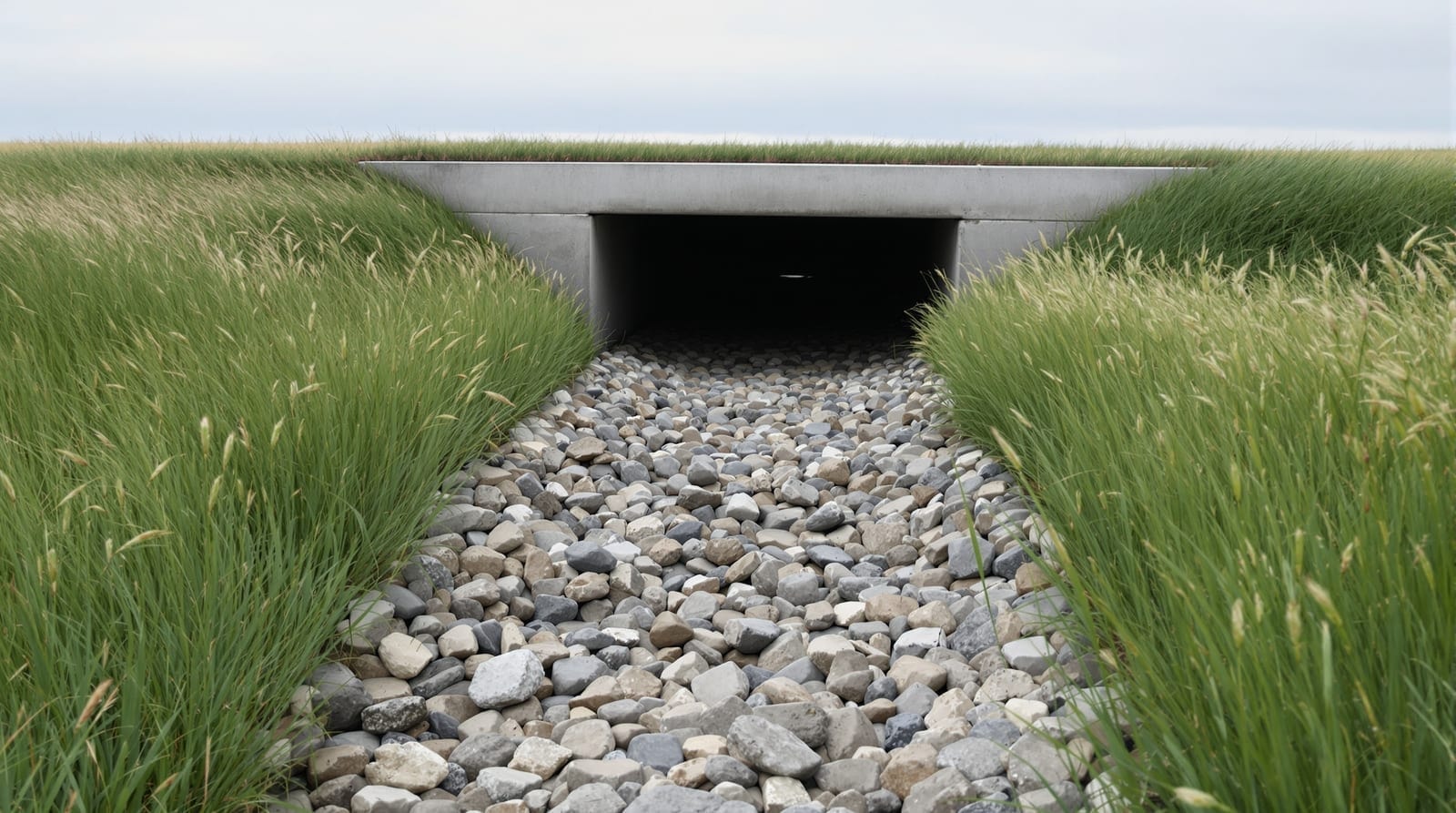
A culvert is a crossing. It provides free passage of surface drainage under a highway, railroad, canal or other embankment, and it is typically a short run — sometimes a single barrel — with the whole embankment bearing on it. Correct culvert design prevents washouts, upstream inundation of adjacent land, erosion at the outlet, and the flooding of the roadway itself. When a culvert fails, the embankment usually fails with it, which is why the class tables for culverts run to considerably greater fill heights than those for storm sewers.
Culverts must therefore be strong enough for both the embankment load and the traffic load, durable, resistant to abrasion and to combustion, and available in a range of shapes. Shape matters more here than in a sewer: where vertical clearance is tight — a shallow crossing under a road with a fixed profile — an arch or horizontal elliptical section delivers the required waterway area within far less rise than a circular pipe of the same capacity. Federal hydraulic design guidance for culverts is published by the Federal Highway Administration.
Why rigid concrete conduit
For both systems concrete pipe is the default rigid option, and for the same underlying reason: the strength is in the product and can be verified before installation. Pipe can be furnished to meet the strength requirements of any practical depth of fill and live load; it is hydraulically efficient; it is non-combustible; and it resists abrasion in a way that matters over decades of grit-laden flow. Concrete pipe has been used for culverts in Illinois since the 1800s and much of that pipe is still serving.
Where to go next
Two questions follow immediately from the choice of system, and each has its own page.
- Which product standard applies? Non-reinforced C 14, reinforced C 76, D-load C 655, arch C 506, elliptical C 507, or precast box under C 789 or C 850 — set out with recommended use in applicable specifications and recommended use.
- Which class does the fill height demand? Selection tables are given separately for storm sewers and for circular culverts, with elliptical and arch culverts tabulated by equivalent round size.
The hydraulic assumptions behind pipe sizing — in particular the roughness coefficient used for each system type — are covered under special considerations.