Fittings: Bends, Tees, Wyes, Transitions and Curves
Real drainage systems change direction, collect branches and meet pipe of other sizes. Concrete pipe fittings are manufactured to handle all three, to the same dimensional and strength requirements as the barrel they connect to.
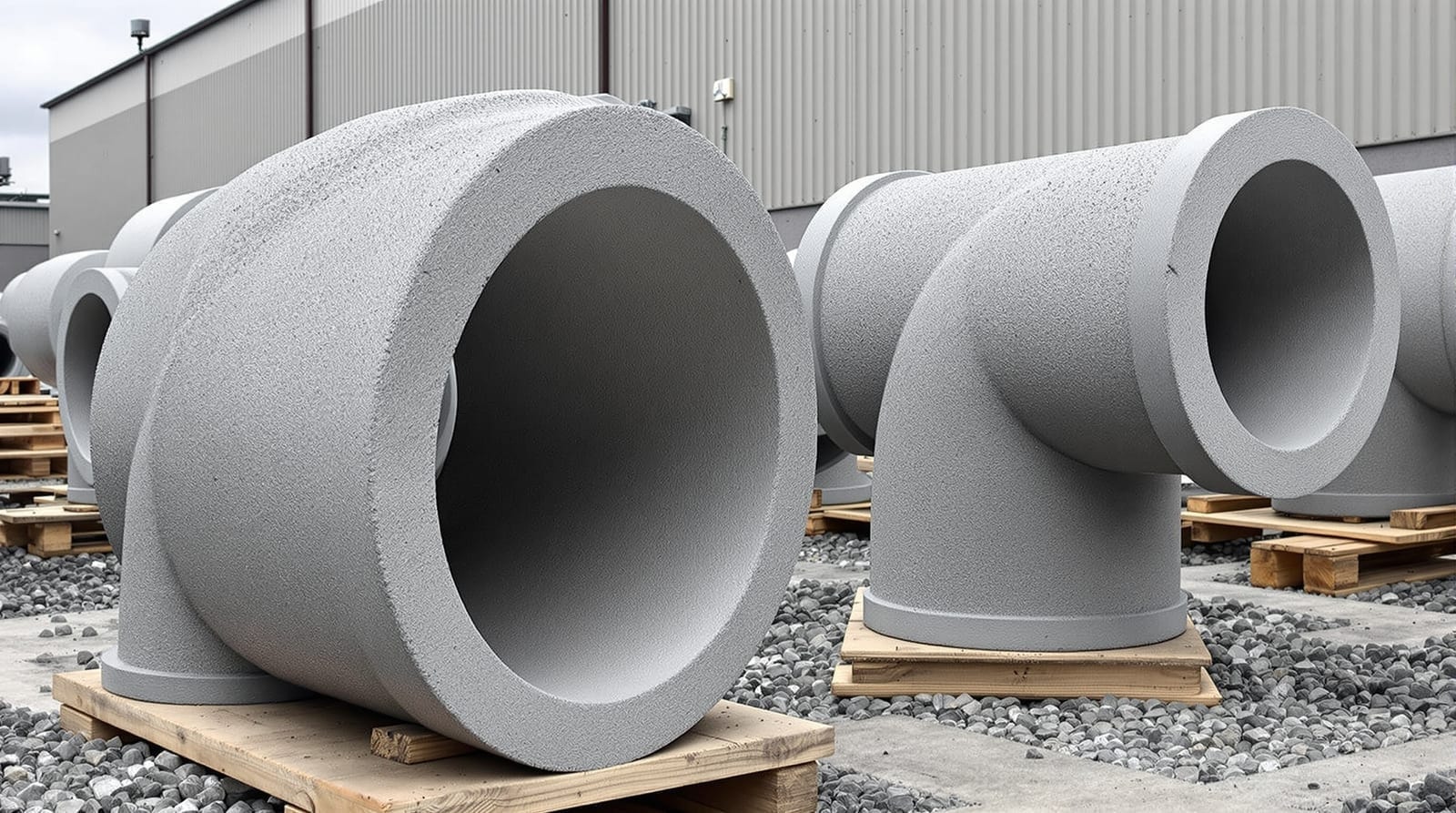
Bends
Bends are furnished in standard ranges of 15-degree angular deflection, although specials can be manufactured to meet any required deflection. The bend is formed by cutting the pipe barrel to the desired bevel, spot welding or tying together the exposed reinforcing, and packing the seams with cement mortar. A pipe bend should be equal in design strength to the abutting pipe — the fitting is a structural member carrying the same earth and live load as everything either side of it, and it is also the point where thrust is greatest.
Tees and wyes
Tees and wyes are standard fittings for all sizes of barrel and branch and are available with all the joint types used on the connecting pipe. All branches terminate in bells or grooves, and the branch is made long enough to permit a proper joint when the connecting pipe is inserted into the branch bell or groove. That length requirement is not incidental: a branch cut short forces the connecting pipe to be jointed partly outside the socket, which is where field connections leak.
Transitions
Special transition pipe sections can be manufactured to accommodate connecting pipe of different diameters. These matter hydraulically as well as mechanically — an abrupt change of section produces losses and, in a sewer, a place for solids to deposit, whereas a manufactured transition maintains a smooth flow line through the change.
Dimensional conformity
The dimensions of all fittings and manhole base tees conform to the dimensions given in the appropriate ASTM pipe specifications. Wall thicknesses and general requirements are therefore the same as for standard concrete pipe, which is what makes fittings interchangeable across suppliers and allows a designer to detail a junction without knowing which plant will supply it.
Curved alignment by joint deflection
Curves in concrete pipelines can be achieved without fittings at all, by opening up one side of a pipe joint while the other side remains in the home position, producing an angular deflection of the pipe axis. Two limits govern how far this can be taken:
- The maximum permissible opening of the joint, which varies by joint configuration and must be obtained from the pipe manufacturer. Exceeding it compromises the seal, which is precisely the failure the technique is supposed to avoid.
- The geometry. The radius of curvature achievable is a function of the deflection angle per joint and the laying length of the pipe section. Shorter sections give a tighter radius for the same permitted deflection, which is why a curve that is impossible in long lengths may be straightforward in shorter ones.
Design data on curved alignment is published in the national design data sheet series; see design aids and the technical literature of the American Concrete Pipe Association.
Availability
It is important to check with local manufacturers for prices and availability of fittings. A design detailed around a fitting that is not produced regionally will either be re-detailed late or built with a field-fabricated substitute, and the second outcome is worse. Where availability is uncertain, a structure-based junction using a precast base tee — see manholes, catch basins and inlets — is usually the more robust design decision.