Introduction
Concrete pipe has been used for sewers and culverts in Illinois for well over a century, and a striking proportion of the earliest installations are still carrying flow. That record is not an accident of luck. It follows from what the product physically is: a rigid conduit that carries imposed load in its own wall, manufactured to a dimensional and strength specification that can be verified by destructive test before it ever reaches a trench.
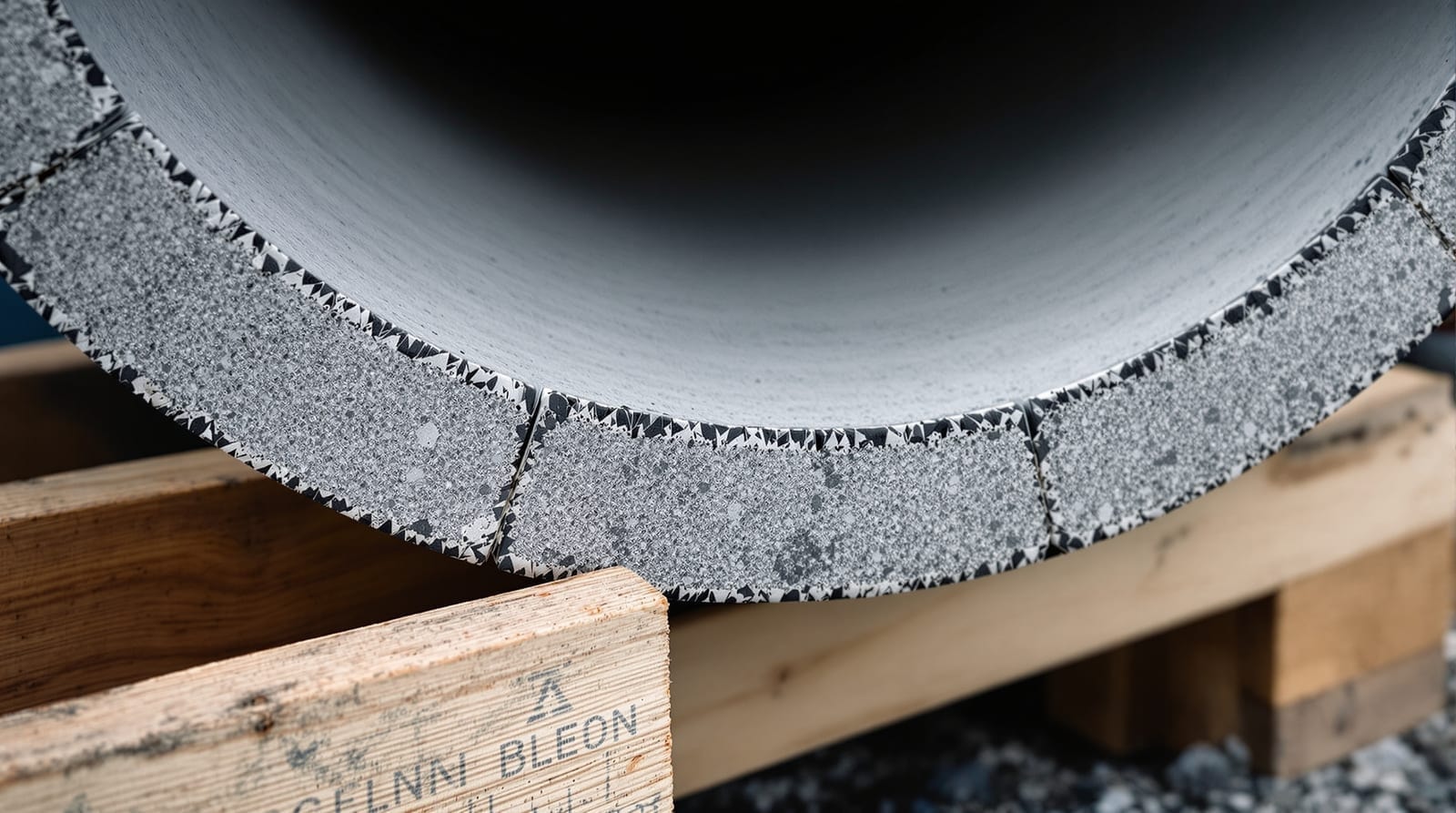
Rigid conduit behaves differently
The single most useful idea for anyone new to this material is the distinction between rigid and flexible conduit. A flexible pipe deflects under earth load and mobilises passive support from the compacted soil beside it; its performance is therefore substantially a property of the installation. A rigid pipe resists load largely in its own structure, and its supporting strength is expressed directly, in a three-edge bearing test, as a D-load. That is why the selection tables in this handbook read as they do: enter with a diameter and a height of fill, come out with a class.
The practical consequences run right through the job. Bedding class still matters, and matters a great deal, because it changes the load factor applied to the pipe's tested strength — but a rigid line does not depend on the contractor achieving a particular soil modulus to survive. Inspection is correspondingly simpler, and acceptance rests on measurable things: certification of the plant, the class marked on the barrel, the integrity of the joints, and the leakage test.
What the specification framework covers
National specifications for concrete pipe are issued by ASTM International, with parallel designations adopted by AASHTO, and are supplemented by the practice manuals of bodies such as the American Society of Civil Engineers. Their purpose is narrow and valuable: to make a product ordered in one part of the country interchangeable with the same designation ordered anywhere else, in physical dimensions, reinforcement, concrete quality and tested strength. A designer specifying ASTM C 76, Class III, 36 in. is specifying a known object, not a description.
The designations divide along product lines. Non-reinforced pipe, reinforced circular pipe, D-load pipe designed to a specific tested strength, arch and elliptical shapes for restricted vertical clearance, low-head pressure pipe, precast box sections in two families, and then a second group of standards for joints, manhole sections, resilient connectors, sealing bands and acceptance testing. The complete index, with AASHTO equivalents and size ranges, is set out in the standards list. Current editions and purchase are handled through AASHTO and ASTM directly.
Reading the tables with governing documents
A handbook table is most useful after the design basis has been stated. Begin with the contract requirements for application, shape, class, joint, bedding and acceptance; then use the corresponding table to compare the available entries. Keep the headings with every copied value, because nominal diameter, actual dimensions, waterway area, wall type and approximate weight answer different questions. English and metric presentations should be treated as separate schedules rather than mixed within a calculation. A dash, qualification or note is part of the entry and should travel with it into a design check.
The table then becomes a coordination tool. The hydraulic opening can be checked against the structural selection, outside dimensions against clearances, and approximate weight against transport and placement planning. Before a schedule is issued, confirm that the referenced standard is the one required by the project and that the selected size, class, wall and joint are available together. Final dimensions and handling data should come from the producer for the supplied product. Where the handbook, a drawing and a specification appear to differ, stop at the difference: identify which document governs, resolve the discrepancy through the project's normal review process, and record the basis used.
Six properties worth separating
Concrete pipe is usually justified as a bundle, which obscures which property is actually doing the work on a given project.
- Hydraulic efficiency. Smooth-wall concrete sits at the favourable end of the roughness range; see hydraulic coefficients for the values ordinarily used in design.
- Structural versatility. Classes and D-load designs cover fill heights from minimum cover to very deep embankment without changing product family.
- Local availability. Sizes, shapes and classes are produced regionally; availability is a real constraint on an otherwise correct design.
- Proven durability. Resistance to abrasion, to fire, and to the ordinary chemistry of domestic sewage; the exceptions — acid wastes and hydrogen sulfide — are treated under special considerations.
- Construction adaptability. Bends, tees, wyes, transitions and flared ends are manufactured to the same standards as the barrel.
- Economy over the life of the asset. The relevant comparison is total cost across a design life measured in generations, not delivered price per foot.
How to use what follows
The rest of this handbook is arranged the way a specifier moves: what the application is, which product standard applies, which class the fill height demands, how the line is jointed, how the structures are built, and how the finished work is tested. Nothing here supersedes a governing document. The tables are reproduced as reference data and the prose is explanatory; the current standard, and the current agency specification, always govern.