Testing: Plant and Field
Rigid concrete pipe is unusual among buried conduits in that its structural capacity is established by destructive test on a sample of the actual product, before installation, and expressed as a number a designer can specify directly. That is the whole basis of the class system, and it is why the selection tables in this handbook can be as short as they are.
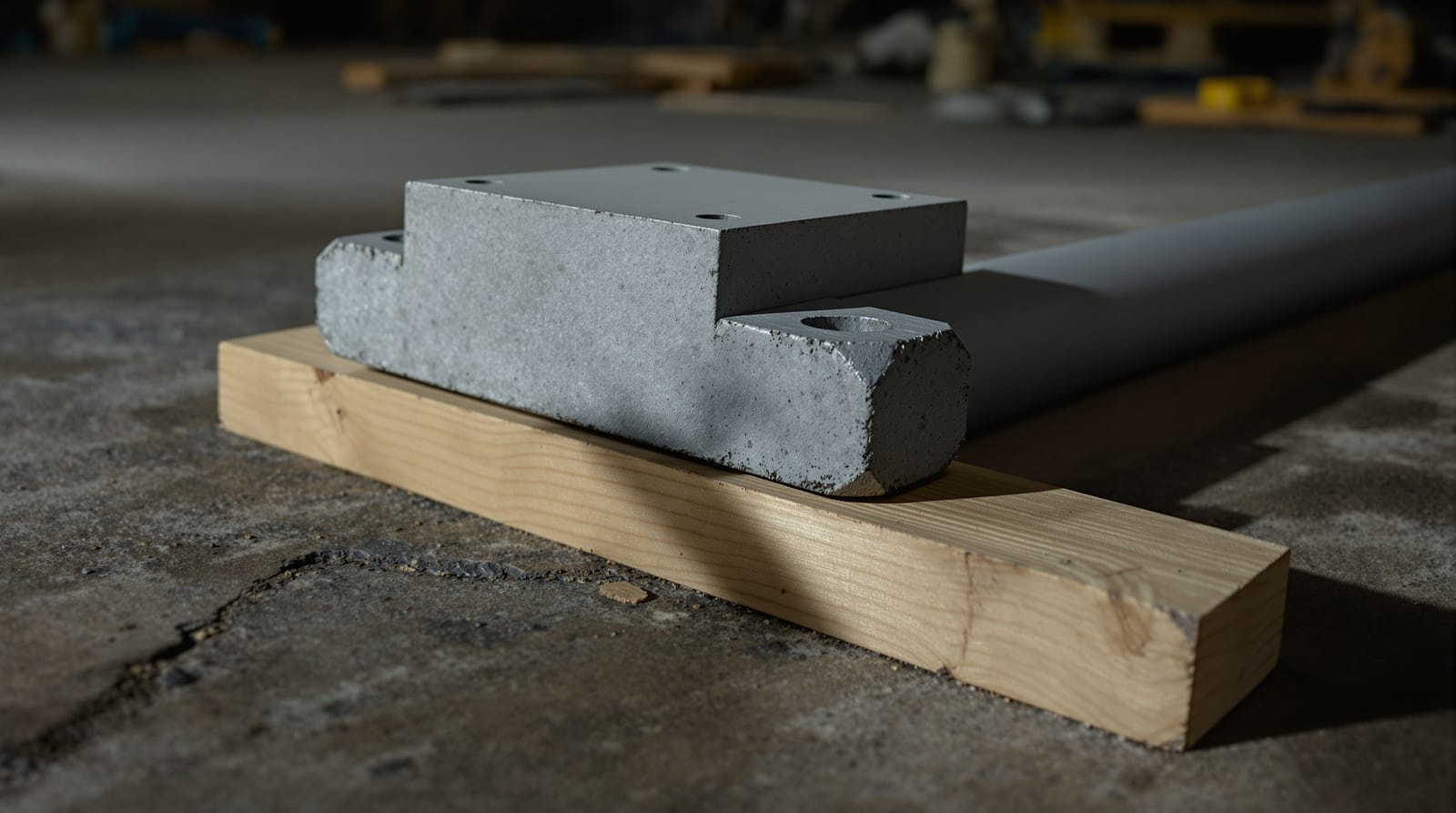
Plant testing
Quality control testing is carried out routinely in the plant to confirm that pipe meets the applicable project specifications. Plants certified by the state transportation department must adhere to rigorous testing requirements, and certification status is itself a specification item — the recommended sanitary sewer specification requires the manufacturer to appear on the department's list of certified plants. Current requirements are published by the Illinois Department of Transportation. Quality control tests in all concrete pipe plants are performed in accordance with ASTM C 497.
ASTM C 497 — standard test methods for concrete pipe, manhole sections or tile
C 497 specifies the three-edge bearing test as the method of determining the maximum D-load of the pipe. A piece of pipe chosen at random is supported on two lower bearing strips and loaded from above through an upper bearing block. Load is applied until a crack is produced 0.01 in. wide over a continuous length of 1 ft.
Two things about that arrangement are worth understanding. First, three-edge bearing is deliberately the most severe support condition that can reasonably be applied — the load is concentrated on three lines rather than distributed around the barrel — so the tested strength is a lower bound, and the installed supporting strength is the tested strength multiplied by a load factor reflecting the actual bedding. Second, the endpoint of the test is a crack of a defined width, not collapse. The pipe is not being tested to destruction; it is being tested to a serviceability limit that the design already anticipates. Why a 0.01 in. crack is a design outcome rather than a defect is explained under significance of cracking.
Where it is wanted, the actual compressive strength of the concrete can be determined by a compressive strength test on a core removed from the pipe.
Hydrostatic joint testing
If the pipe for a project must meet the requirements of ASTM C 443, a hydrostatic test may be performed to confirm joint integrity. The joint between two pipes is subjected to an internal hydrostatic pressure of 13 psi for 10 minutes, in both straight and deflected alignment. Testing in the deflected position is the part that matters: a joint that seals when perfectly aligned and opens when deflected is of little use in a real trench.
Field testing
In special circumstances, where infiltration or exfiltration rates are a concern, one of the following field tests may be performed to demonstrate the integrity of the installed line. These tests evaluate the construction, not the product — see leakage allowances for what a limit is actually buying.
ASTM C 969 — infiltration and exfiltration acceptance testing
C 969 covers procedures for testing installed precast concrete sewer lines using either water infiltration or water exfiltration acceptance limits, to demonstrate the integrity of the installed materials and of the construction procedure. It is the whole-line test: a measured quantity over a measured reach, typically manhole to manhole.
ASTM C 1103 — joint acceptance testing
C 1103 covers procedures for testing the joints of installed precast concrete pipe sewer lines, using either air or water under low pressure, to demonstrate the integrity of the joint and of the construction procedure. It applies to 27 in. and larger diameter lines with rubber gasket sealed joints. Smaller diameter lines are typically tested by infiltration or exfiltration under C 969.
The size threshold is practical: at 27 in. and above a line can be entered and each joint tested individually, which localises a failure to a single joint instead of condemning a whole reach. Below that diameter the whole-line test is the only economical option.
ASTM C 924 — low-pressure air test
C 924 covers low-pressure air testing of concrete pipe sewer lines and is one of the acceptance options in the sanitary sewer specification. Air testing is quick and needs no water supply, which is why it is common; it is also more sensitive than a water test, and results must be interpreted against the standard's own acceptance criteria rather than against intuition.
Reading a test result
A failed test is a starting point, not a verdict. The usual causes, in rough order of frequency, are a gasket pinched during installation, a joint not pulled fully home, damage to a barrel during handling or backfill, and groundwater entering at a structure connection rather than at the pipe. Each is locatable, and each is a construction defect with a construction remedy. Metrological traceability for the instruments used in any of these tests ultimately rests on the national measurement infrastructure maintained by NIST.
Records, repairs and retests
A usable test record identifies what was tested and under which acceptance procedure. It should tie the result to the pipe reach or individual joint, record the test method and specified limit, identify the equipment used and its calibration status, and describe relevant site conditions. Preparation matters as well: plugs, connections, groundwater observations and the condition of adjoining structures can affect how a result is interpreted. Recording the initial reading, the test interval, the final result and the personnel present gives the owner a traceable account instead of an isolated pass or fail notation.
When a test fails, locate and document the defect before repair. The repair record should identify the affected joint, barrel or structure connection, state what was corrected and link that work to the follow-up test. A passing retest demonstrates that the tested reach or joint met the applicable acceptance criterion under the retest conditions. It does not by itself establish why the first test failed, prove the condition of an untested reach or erase observations made during inspection. Keeping both results preserves the construction history and lets the engineer distinguish a corrected local defect from a pattern that calls for broader examination.