Joints, Gaskets and Sealants
A pipeline is a series of joints connected by lengths of pipe, and on most projects the joints decide whether the line performs. Joint configurations divide into bell and spigot, tongue and groove, and modified tongue and groove. Sealing systems divide into cement mortar and mastic compounds, rubber gaskets, external sealing bands, steel end rings, and butyl or bitumen rope.
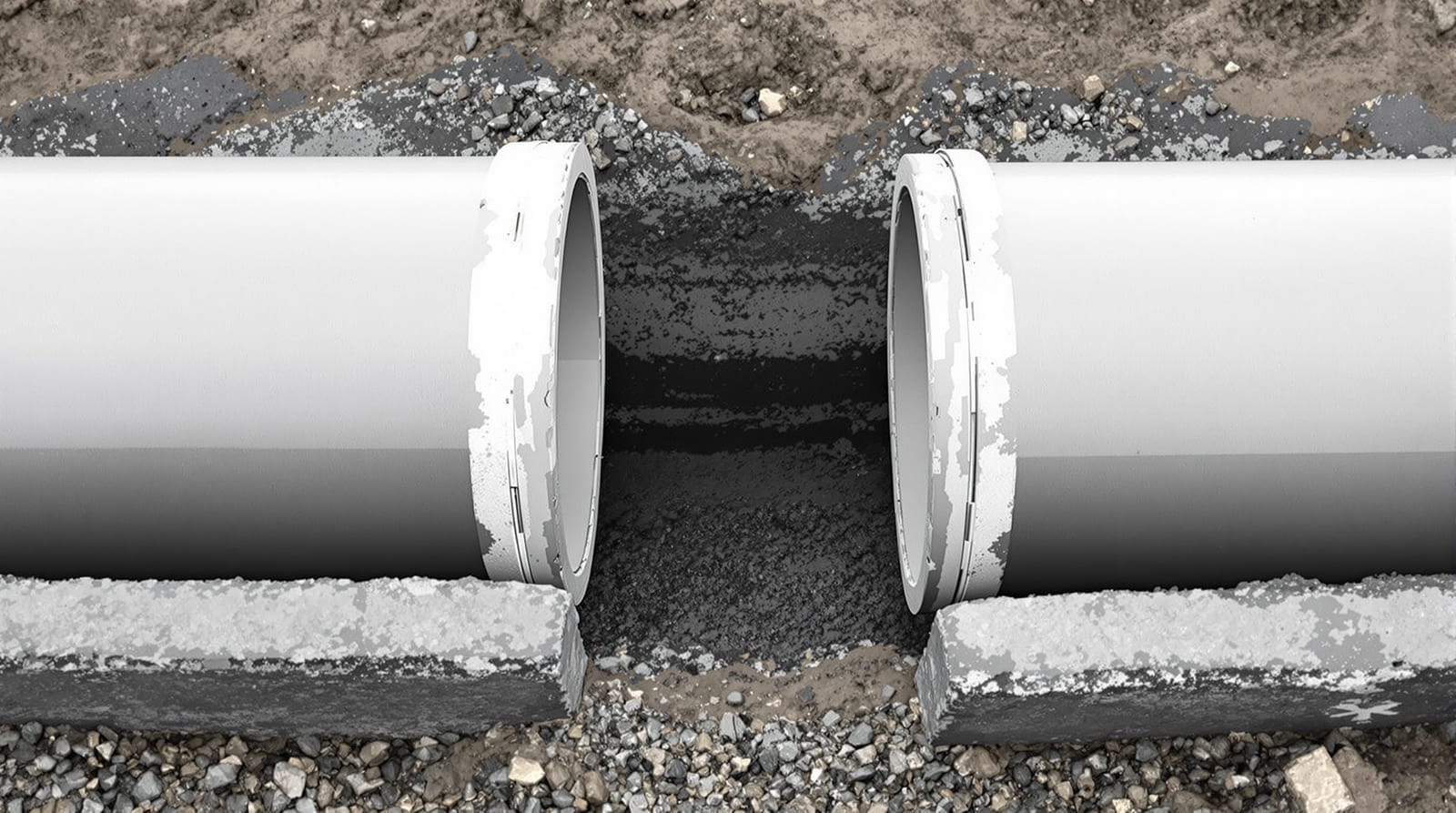
What a joint is asked to do
Permissible infiltration and exfiltration rates are the usual headline requirement, but a joint is carrying several other duties at once, and specifying only for leakage misses most of them:
- resistance to infiltration of backfill material — keeping fines out is a structural concern as much as a hydraulic one;
- control of leakage under internal or external pressure;
- flexibility to accommodate lateral deflection and longitudinal movement without opening;
- continuity of the pipeline and a smooth flow line, so the joint does not become a hydraulic obstruction or a solids trap;
- where the line serves subsurface drainage, deliberate admission of groundwater;
- and ease of installation, which is not a comfort issue — a joint that is difficult to make correctly will be made incorrectly somewhere along the run.
Cement mortar and mastic compound
Circular pipe, special shapes and boxes are available with tongue and groove joints packed with cement mortar, filled with a preformed butyl or bitumen gasket sealing compound, or sealed with a trowel-applied mastic. These have a long and successful record and are generally used for storm sewer construction. Properly applied mastic fillers provide flexibility and help keep fines out of the pipe. They are not the choice where a defined leakage limit must be demonstrated by test.
ASTM C 443 — joints using rubber gaskets
Where infiltration or exfiltration is a design factor, the recommended joint for circular sewers is a flexible watertight joint using a compression-type rubber gasket. C 443 joints are intended for use with pipe manufactured to ASTM C 76 and may be used with either bell and spigot or tongue and groove ends. The joint is made up of concrete surfaces with a compression-type rubber gasket; O-ring type joints also meet the performance requirements of C 443. This is the default sanitary sewer joint and the one assumed by the leakage allowances discussed under leakage allowances.
ASTM C 361 — low-head pressure pipe joints
C 361 covers both low-head pressure pipe and the joints for it, and is referenced here for special conditions of internal or external head. C 361 joints can be supplied for use with pipe manufactured to ASTM C 76. The joint is made up of concrete surfaces with a groove on the spigot for an O-ring rubber gasket — a confined O-ring joint. The standard makes provision for an alternative joint where approved by the owner. These joints are normally used in gravity sewers where exceptional tightness is required; they meet all the joint requirements of C 443. Steel end rings may also be used for the special condition of pressure flow.
ASTM C 877 — external sealing bands
For special conditions where an effective rubber seal is wanted on non-circular pipe — arch, elliptical and box shapes — an external sealing band meeting ASTM C 877 is available. These bands are generally limited to non-circular pipe with tongue and groove configurations. C 877 describes specific types; other types giving adequate results may also be specified. The external band exists because a compression gasket seated in a circular groove has no straightforward equivalent on a non-circular section.
ASTM C 990 — preformed flexible joint sealants
C 990 joints are intended for circular pipe, elliptical pipe or precast box sections and may be used with either bell and spigot or tongue and groove ends. The joint is made up of concrete surfaces with a preformed bitumen or butyl rubber sealant, commonly called bitumen or butyl rubber rope. C 990 is also the usual sealant standard for manhole and box section joints, where a compression gasket is impractical.
Groundwater and installation conditions
Joint selection begins with the direction and persistence of water pressure, not simply with whether the pipe carries storm water or sewage. Groundwater above the line can drive infiltration and carry fines toward an imperfect joint; internal head can drive exfiltration in the opposite direction. Seasonal or construction dewatering may hide that condition while the trench is open, so the design basis should reflect the expected service condition. Connections at manholes, inlets and transitions deserve separate attention because a tight pipe joint does not make an adjoining structure connection tight.
Installation conditions determine whether the selected detail can be made consistently. Trench width, access, line and grade, joint deflection and the ability to inspect the completed closure all affect workmanship. Joint surfaces need to be clean and sound, gaskets or sealants kept in the required position, and the section supported so bedding material does not force the joint out of alignment. The crew should be able to recognise a rolled gasket, displaced sealant or incomplete closure before the joint is covered. Where settlement or movement is expected, the specified joint must accommodate the design condition without relying on field improvisation. No joint system compensates for a damaged end, unsuitable bedding or an unverified structure connection.
Choosing
In practice the decision runs: is there a head condition or a leakage limit to be demonstrated? If not, mortar or mastic on a tongue and groove joint is adequate and economical. If there is, move to a C 443 gasketed joint; if the tightness requirement is exceptional or a pressure condition exists, to C 361 with a confined O-ring, and consider steel end rings. For non-circular sections, an external sealing band under C 877 or a preformed sealant under C 990. Manhole and structure connections are a separate case, treated under manholes, catch basins and inlets; the full standards index is at standards: joints, connectors and testing.