Applicable Specifications and Recommended Use
Choosing a product standard is the decision that constrains everything downstream — the available sizes, the joint options, how strength is expressed, and whether the section can be furnished at all in a given region. The families below cover essentially all rigid concrete drainage conduit in ordinary Illinois practice. AASHTO publishes parallel designations for each; both sets are indexed in the standards list and are available through the AASHTO store.
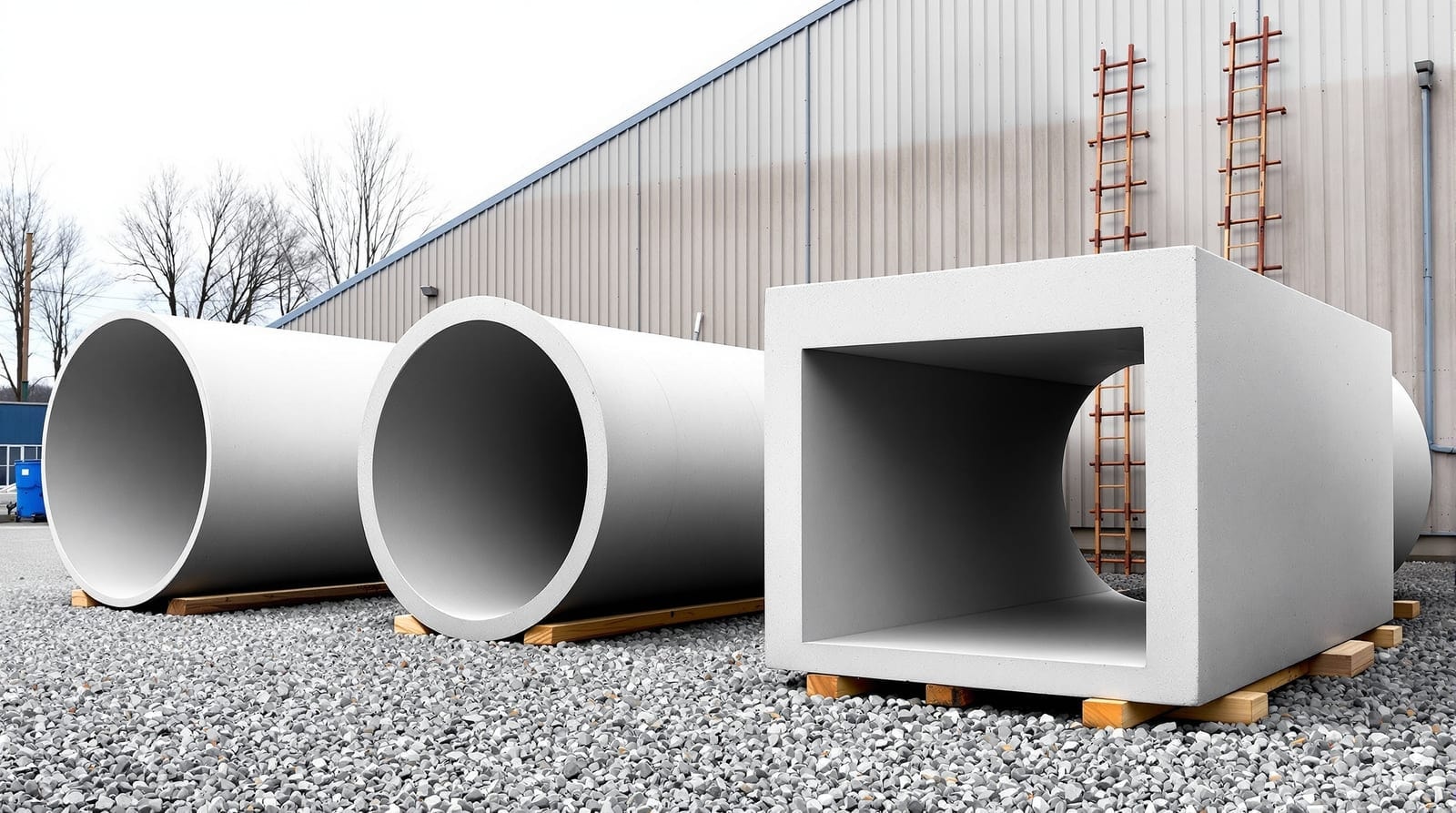
Circular pipe
ASTM C 14 — non-reinforced concrete sewer, storm drain and culvert pipe
C 14 pipe is the correct product for the 8 in. and 10 in. diameters. It may be used from 12 in. through 36 in. provided that reinforced C 76 pipe of comparable strength is also specified, so that the contractor is not left with a single non-reinforced option where site conditions turn out to demand more. Joints for most storm sewer work are cement mortar or mastic compound; where an internal or external head condition exists, joints meeting ASTM C 443 with a rubber gasket should be specified instead.
ASTM C 76 — reinforced concrete culvert, storm drain and sewer pipe
C 76 is the workhorse. It covers 12 in. through 144 in., is furnished with bell and spigot or tongue and groove ends, and is available with cement mortar or mastic joints for ordinary culvert and drainage installations or with C 443 or C 361 gasketed joints where head conditions require them. It is the most commonly specified storm sewer pipe for four reasons that are worth stating separately: hydraulic capacity, resistance to abrasion and combustion, the ability to meet essentially any load condition through the class system, and the breadth of related appurtenances manufactured to match it. Dimensions and approximate weights are tabulated under circular pipe dimensions and weights.
ASTM C 655 — reinforced concrete D-load culvert, storm drain and sewer pipe
C 655 covers the same 12 in. through 144 in. range but designs the pipe for a specific D-load strength rather than a standard class, with acceptance based on statistical analysis of test specimens. Its physical properties otherwise track C 76. It is the right choice when the required supporting strength falls awkwardly between standard classes, or when a project's loading is unusual enough that designing to it directly is more economical than rounding up.
Special shapes and precast boxes
ASTM C 506 — reinforced concrete arch culvert, storm drain and sewer pipe
Arch pipe is furnished from 18 in. through 132 in. equivalent circular size with tongue and groove cement mortar or mastic joints. Its purpose is vertical clearance: minimum-cover situations, or any crossing where the road profile or an existing utility limits rise. It also offers a hydraulic advantage, delivering greater capacity at the same depth of flow than most other structures of equivalent waterway area. Under similar cover, loads are comparable to those on circular pipe of the same span. Where arch pipe is not produced locally, elliptical pipe substitutes as an equivalent.
ASTM C 507 — reinforced concrete elliptical culvert, storm drain and sewer pipe
Horizontal elliptical pipe covers 18 in. through 144 in. equivalent circular size with tongue and groove cement mortar or mastic joints. Installed with the major axis horizontal, it serves the same minimum-cover and restricted-clearance conditions as arch pipe. C 507 also defines vertical elliptical classes, installed major axis vertical, for the opposite constraint — a narrow trench or a deep installation where horizontal space rather than height is scarce. Dimensions are given under elliptical pipe dimensions and weights and class selection under Table IIB.
ASTM C 789 and ASTM C 850 — precast reinforced concrete box sections
Precast box sections cover spans and rises in the 3 ft to 12 ft range and are specified where a very large waterway area is needed within limited rise, or where a rectangular section suits the hydraulic or structural situation better than a round one. The two standards differ in cover condition: C 789 is the general case, while C 850 covers sections with less than 2 ft of cover subject to highway loading — the shallow crossing where wheel loads reach the top slab most directly, which is why C 850 sections are the heavier of the two at the same span and rise. Both are tabulated under box section dimensions and weights.
Choosing between them
In practice the sequence is: establish the required waterway area from the hydraulic design; check the vertical clearance available; if clearance is adequate, specify circular pipe under C 76 (or C 14 at the two smallest diameters); if it is not, move to arch or horizontal elliptical at the equivalent round size; if the area required is larger than any practical single round section or the geometry is rectangular, move to a precast box. Then enter the class tables with the fill height. Joint selection follows from the head condition and is treated separately under joints.