Flared End Sections
A flared end section is the transition between a buried conduit and the open channel or ditch at either end of it. Precast flared end sections for circular concrete pipe are manufactured in diameters from 12 in. through 84 in., with the groove end on the outlet section and the tongue end on the inlet section. Sections are also available for many sizes of arch pipe, elliptical pipe and precast box sections.
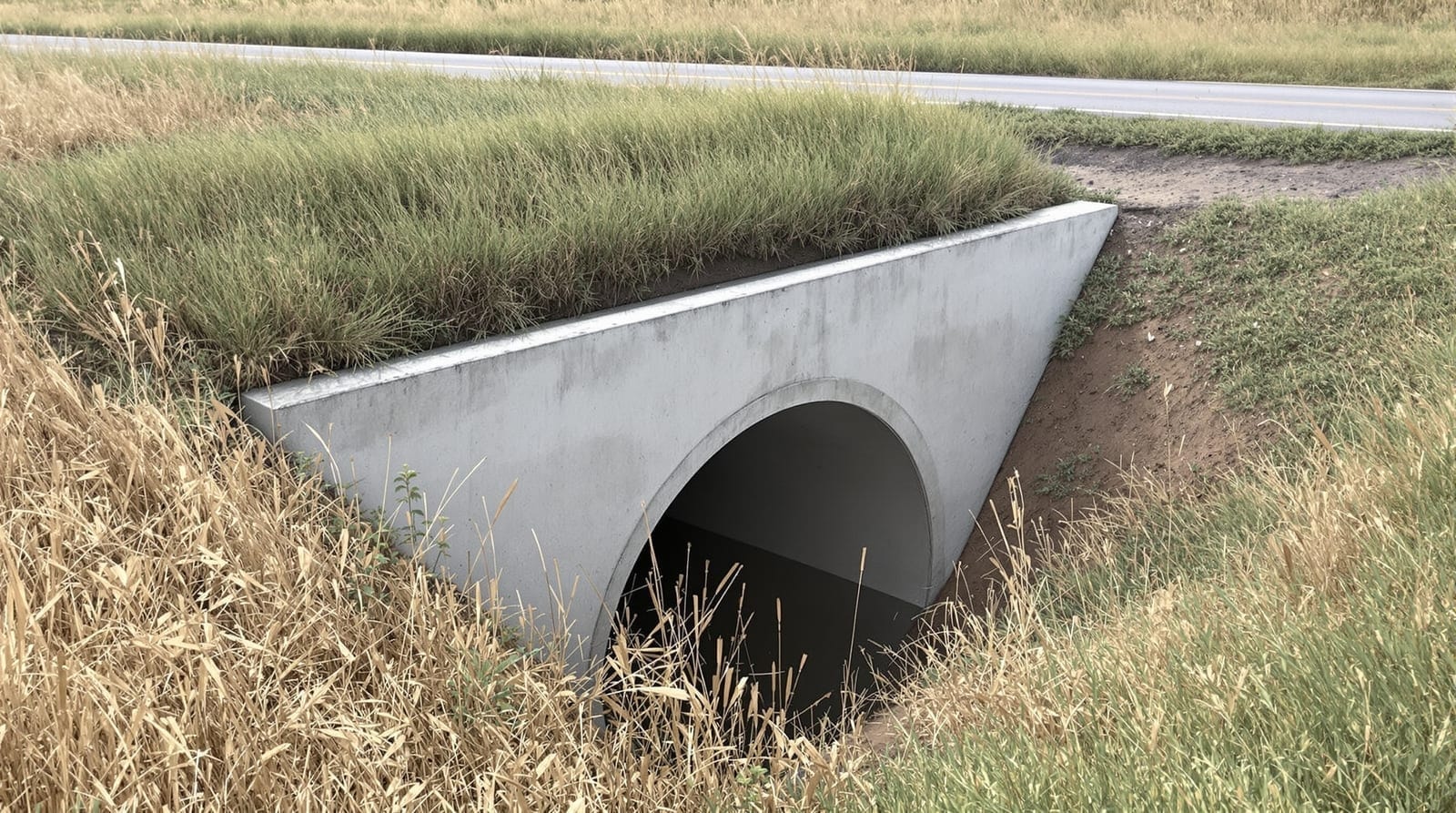
What the end section is actually doing
It is easy to treat end treatment as finishing work. It is not: the ends of a culvert do more to determine its performance and its service life than any equivalent length of barrel.
- Hydraulic entry. A great many culverts operate in inlet control, meaning the capacity of the whole crossing is set at the upstream face. A projecting, unimproved pipe end is the least efficient entrance condition there is; a flared section improves the entrance loss coefficient and can raise capacity materially without any change to the barrel. Federal guidance on entrance conditions and performance curves is published by the Federal Highway Administration.
- Outlet protection. At the discharge end the flare spreads and slows the jet, reducing the scour that otherwise undercuts the last pipe length and progressively removes the embankment toe.
- Embankment retention. The section holds the fill slope back from the opening, so the end of the conduit does not become a place where the embankment slumps into the waterway.
- Debris and safety. A defined, sloped end is far less hazardous to an errant vehicle or a person than a blunt projecting pipe, and is more readily grated.
Grates
Steel grates are available for all types of flared end sections. The trade-off is worth stating plainly, because it is a genuine engineering judgement rather than a default: a grate reduces the risk of a person or animal entering the conduit and keeps large debris out of a line that cannot be cleaned easily — but every grate is also a place where debris accumulates. A blocked grate converts a working culvert into a dam, and the resulting overtopping can do more damage than the hazard the grate was fitted to prevent. Grates therefore belong where the entry hazard is real and where the structure will actually be inspected and cleared on a cycle.
Toe blocks
Toe blocks may be employed to support the outlet of flared end sections. They serve two related purposes: they provide bearing at the downstream lip so the section does not settle or rotate as the channel below it degrades, and they act as a cut-off against undermining, so scour beneath the apron does not progress back underneath the section.
Orientation and installation
The tongue and groove convention — groove end on the outlet section, tongue end on the inlet section — exists so that each end section makes up correctly against the barrel with the joint facing the way the flow does. It is a small detail that is straightforward to get wrong on site when sections arrive together and look similar. Sections should be bedded on the same material as the barrel and to the same standard; a flared section resting on disturbed ground at the end of a properly bedded line is the piece that moves.
Related sections
Bends, tees, wyes, transitions and deflected joints are covered under fittings. Where the barrel is arch or elliptical, dimensions and class selection are at Table IIB. The roughness assumptions used in sizing the barrel are discussed under hydraulic coefficients.